



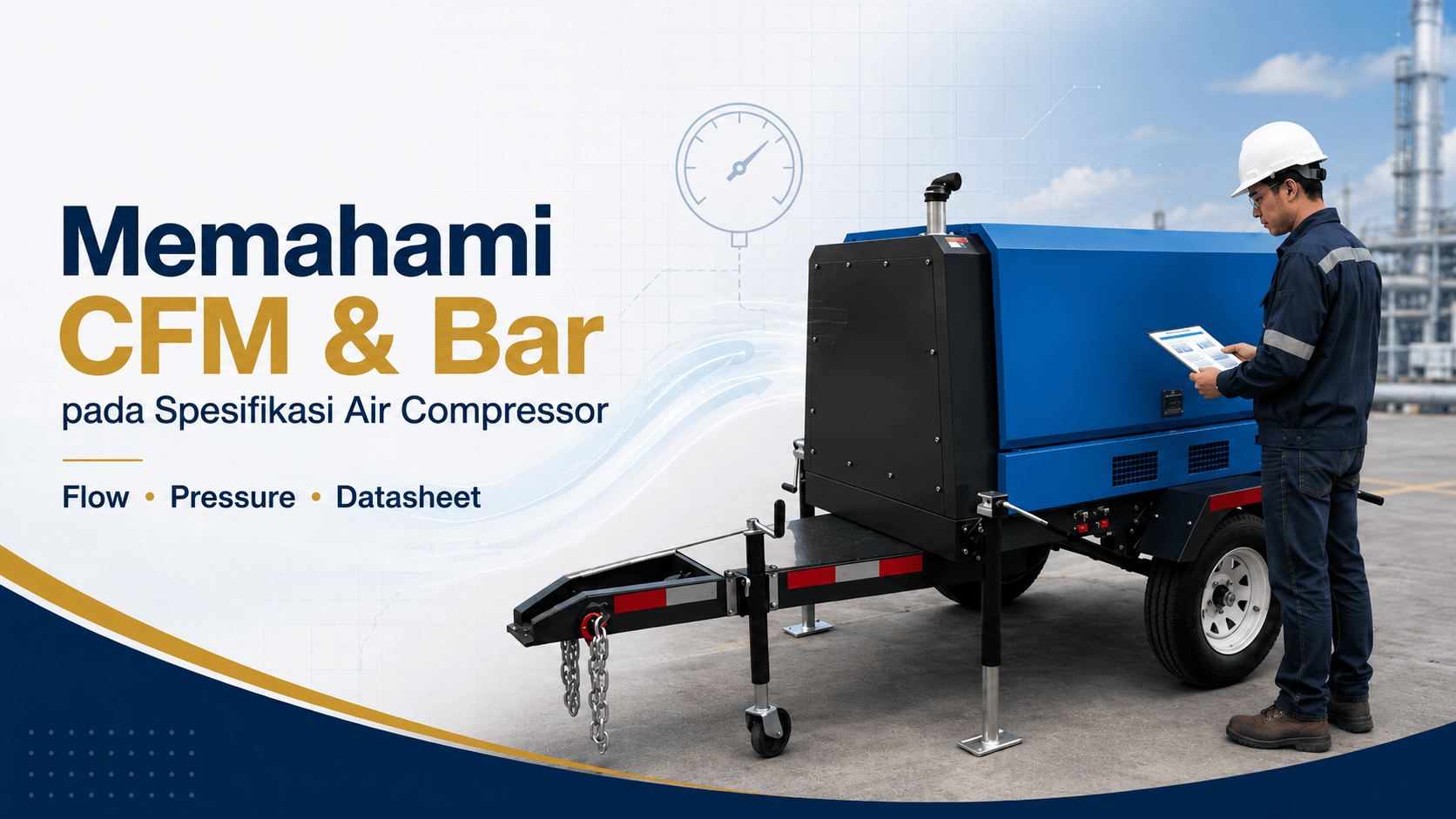
Understand CFM and BAR on Air Compressor Specifications – When reading the air compressor specifications, the two numbers that attract most attention are: CFM and bar. Both are equally important, but explain different things.
CFM is related to Flow or air volume per unit time, while the bar is related to Pressure or pressure. Because the functions of the two are different, large flow numbers cannot replace the need for pressure, and high pressure does not automatically cover the shortage of flow.
The problem is, reading numbers is not enough. Datasheet compressor can use terms such as CFM, ACFM, SCFM, Free Air Delivery or FAD, Displacement, Working Pressure, or Maximum pressure. Some terms look similar but have different measurement bases or operating contexts. CAGI and the compressor manufacturer itself explicitly distinguish the terminology.
Therefore, the safer way to read specifications is:
Parameter Name → Value → Unit → Definition → Measurement Base → Operating Context → New compared
If you are translating these parameters into purchase or RFQ requirements, Construction Equipment RFQ Checklist Can be used to separate technical requirements from commercial and logistic requirements.
In This Article
Why CFM and bar should be read together?
Flow and pressure are two different parameters.
Atlas Copco describes airflow as the amount of air that can be given a compressor, while pressure indicates the need for pressure to run a job or application. In the sizing process, the manufacturer also asked both to be checked based on requirements tools or applications.
Simply put:
| Factors | CFM / FLOW | Bar / Pressure |
|---|---|---|
| What is explained | volume/air flow per time | stress |
| sample unit | CFM, M³/min, L/S | Bar, PSI, KPA |
| question | How much air is available? | At what pressure is the air available/needed? |
| Can replace other parameters? | No | No |
| there should be a context? | aye | aye |
A compressor can have a large flow but pressure that is not in accordance with certain application requirements. The opposite condition is also possible.
Therefore, avoid the approach:
“Higher CFM means the compressor is definitely more suitable.”
or:
“Higher bar means better performance.”
What is CFM on an air compressor?
CFM stands for Cubic Feet Per Minute and is the unit of volumetric flow rate.
CAGI defines CFM as the volumetric air-flow rate. Atlas Copco also explained that volumetric flow is a volume of fluid that moves per unit of time and can be expressed, among others, in CFM, L/S, or other volumetric-flow units.
But there is a more important question:
CFM in what condition?
The gas volume changes with the conditions of pressure and temperature. Therefore, the volumetric flow figure must be read with the reference condition or the field definition used by the manufacturer. Atlas Copco explicitly emphasizes that the volume of the gas changes to the inlet temperature and pressure so that the flow statement needs to state the applicable conditions.
So:
CFM is a unit. FAD/ACFM/SCFM helps to explain the basis or how the flow is stated.
What is Free Air Delivery and other Flow terms?
Free Air Delivery — FAD
Atlas Copco explained Free Air Delivery As the delivered flow is measured at the outlet then converted back to the condition Free water or inlet conditions. FAD is used to compare the compressor and connect the compressor capacity with air consumption, but the comparison still needs to be done in compatible conditions.
Kaeser gives the definition of the same: CFM FAD is the air that is delivered at a point and then referenced back to the ambient/free-air condition.
acfm
CAGI defines acfm As the actual volume flow under conditions prevailing in the compressor inlet.
In certain CAGI Performance Datasheet, the manufacturer even writes explicitly that acfm It is the actual cubic feet per minute in inlet conditions and capacity is measured according to ISO 1217.
scfm
scfm means flow referenced to a standard set of conditions.
But don't just look at the letter “S” and immediately assume all datasheets use identical standard conditions. CAGI shows some reference temperatures that can appear in specification practice and emphasize the need to mention reference conditions.
Displacement
Displacement is not automatically FAD.
CAGI defines displacement as a piston or rotor-swept volume per unit of time. It is a different parameter of actual delivered airflow.
Therefore, compare:
Compressor A: Displacement X
in :
Compressor B: FAD Y
Without additional definitions are:
Not directly comparable
FLOW TERMINOLOGY TABLE
| term | used for | Do not assume immediately as | which must be verified |
|---|---|---|---|
| CFM | Volumetric Flow Unit | FAD or SCFM | Field name and condition |
| CFM FAD | Delivered Flow Reference to Free-Air Conditions | Displacement | Reference Condition |
| acfm | Actual Volumetric Flow | scfm | Actual Conditions |
| scfm | Flow in Standard Reference Conditions | acfm | Standard used |
| icfm | Compressor Inlet Flow | Delivered Output | Rated Inlet Condition |
| Displacement | Swept Volume | Actual Delivered Airflow | manufacturer definition |
The terminology above follows CAGI and KAESER; in actual datasheet, the definition of the manufacturer remains the main base.
What is a bar on an air compressor?
bar is a unit of pressure.
CAGI defines pressure in general as the force per unit area, while the discharge pressure is the pressure generated on the discharge port compressor. Kaeser further distinguishes between Rated Discharge Pressure and Required Discharge Pressure.
This is important because the datasheet can use terms such as:
- Working pressure;
- Rated pressure;
- Effective Working Pressure;
- Maximum pressure;
- Operating pressure.
The term should not be considered identical just because they all use bar or psi.
For example:
Maximum Pressure ≠ Automatic Normal Working Pressure
unless the manufacturer defines it so.
difference between flow and pressure
A quite helpful analogy is the water system:
- flow similar to the amount of volume that passes in a certain period;
- pressure describe the pressure level that drives the medium.
But the analogy is only to make understanding easier. In technical matching, return to Actual Definition and Specification.
Atlas Copco explicitly suggests that the Compressor Selection considers Airflow Requirements and Pressure Requirements, not just horsepower.
So:
Flow replied “How much?”
Pressure answered “at what pressure level?”
Both must be checked together.
CFM, M³/min, and L/S: when can the numbers be converted?
CFM, M³/min, and L/S are volumetric flow units.
Unit:
- 1 CFM 0.0283168 m/min
- 1 CFM 0.471947 L/s
However, the conversion only changed unit, not measurement base.
Meaning:
100 CFM FAD should not be automatically compared with the value labeled SCFM only after the numbers are converted to m³/min if the reference conditions are both not confirmed to be compatible.
Atlas Copco and CAGI emphasize that volumetric flow is influenced by reference/inlet conditions and that SCFM, ACFM, and FAD have a presentation base that needs to be checked.
Example of Unit Conversion — Not Product Matching
Bar, PSI, and other pressure units
Pressure can be stated in the following:
- bar;
- PSI;
- KPA;
- MPA.
Unit:
- 1 bar 14,5038 psi
- 1 psi 0.06895 bar
NIST provides reference conversion for pressure, including Pascal, PSI, atmosphere, and other pressure units.
But again:
unit conversion field equivalence.
If compressor A lists Working Pressure and compressor B lists Maximum pressure, changing both values to the unit bar does not automatically make both direct comparisons.
how to read flow and pressure on datasheet
Use the following order.
1. Make sure the exact model
Do not take the specifications of models that have only similar names.
2 .Read the field name
For example:
- Free Air Delivery;
- Actual Free Air Delivery;
- ACFM;
- SCFM;
- displacement;
- Rated pressure;
- Working pressure;
- Maximum pressure.
3 .Record the value and unit
Do not separate the value from the unit.
4. Find the definition
Use:
- datasheet;
- footnote;
- manual;
- Performance sheet;
- Technical Glossary Manufacturer.
5 . Check reference conditions
Special Volumetric Airflow, look for:
- inlet pressure;
- inlet temperature;
- Humidity;
- standard/reference base.
6. Just do a comparison
Workflow:
Parameter → Value → Unit → Definition → Reference Condition → Compare
Generic example:
| field | value | question |
|---|---|---|
| Air Delivery | X | FAD, ACFM, SCFM, or others? |
| Pressure | Y | Working, rated, or maximum? |
| Unit | CFM/M³/min/bar | Need a conversion? |
| reference | — | What is the measurement condition? |
How to compare two compressors correctly
Do not immediately place two datasheets side by side and choose the largest number.
Use:
| Parameters | Compressor A | Compressor B | Status | Notes |
|---|---|---|---|---|
| Flow Terminology | fad | fad | Exact Comparable | If the reference base is the same |
| Flow Terminology | acfm | scfm | Need Definition | Different base |
| FLOW UNIT | CFM | m/min | Comparable after unit conversion | If the base is the same |
| Pressure Field | Working Pressure | Working Pressure | compatible | If the context is the same |
| Pressure Field | working | maximum | Not directly comparable | Different Fields |
| Identity Model | exact | exact | compatible | Source must match |
| application | be known | be known | contextual | Requirements are still needed |
Use status:
- Exact Comparable
- Comparable after unit conversion
- Not directly comparable
- Need Manufacturer Definition
- Insufficient Data
CFM and BAR Relationship with Pneumatic Tools
Once the CFM and bar are understood, then the numbers are used in Technical Matching:
Tool/System Requirement → Required Flow → Required Pressure → Compressor Datasheet → Comparison
Atlas Copco also explained that various tools have different airflow requirements and pressures, so sizing must start from application requirements.
Detailed discussion of the number of jack hammer, simultaneous load, hose, coupling, and compressor sizing remains the ownership article:
How to choose an air compressor for a jack hammer and pneumatic tool 3
the url of the production of the article I haven't entered Because there is no evidence URL Current that is sufficient in the available source.
Common error reading air compressor specifications
Avoid the following errors:
- Reading CFM without knowing the base flow;
- Equalize FAD with displacement;
- Assuming ACFM and SCFM are automatic the same;
- Converting units without checking reference conditions;
- Assuming a higher bar is always better;
- Comparing Maximum Pressure with Working Pressure;
- Just see the flow without pressure;
- Just see pressure without flow;
- using specification without exact model;
- take numbers from promo articles as current technical truth;
- mixing PDS175 and PDS185;
- Choose a compressor only from the largest number.
Checklist before using CFM numbers and bar for matching
Before using the numbers from the datasheet, check:
- Exact Brand and Model.
- Field Specification Name.
- value.
- unit.
- FAD/ACFM/SCFM/Displacement Terminology.
- reference condition.
- Working vs Maximum Pressure.
- Datasheet version/date.
- application context.
- target requirements.
- whether the unit needs to be converted.
- Is the measurement of the basis of two products really comparable.
If one of the important parameters is not available:
The data is not enough.
FAQ
What does CFM mean in Air Compressor?
CFM is Cubic Feet Per Minute, namely the volumetric airflow unit. For technical comparisons, the CFM numbers must still be read with the terminology and reference conditions.
What does the bar on the air compressor mean?
The bar is a unit of pressure. The value needs to be read with field names such as Working, Rated, or Maximum Pressure.
What is the difference between CFM and BAR?
CFM is related to airflow, while bar is related to pressure. Both are different parameters and cannot replace each other.
Is the bigger CFM always better?
No. Compressor needs to meet the flow and The pressure required for the application.
Is the higher bar always better?
No. Application or pneumatic tool has a certain pressure requirements. Higher nominal value is not a reason to use pressure outside the manufacturer's specification.
What is Free Air Delivery or FAD?
FAD is a delivered airflow that is declared back to the free or inlet-air reference conditions according to the definition used.
Is FAD the same as displacement?
No. Displacement is a swept volume of piston/rotor per unit of time, while FAD is related to the actual delivered airflow that is referenced to a certain condition.
What is the difference between CFM and M³/min?
Both can be different volumetric flow units. Conversion unit can be done if the measurement base is the same.
Can CFM be directly converted to m/min?
Units can be, but Conversion does not convert FAD to SCFM or equalize different reference conditions.
What is the difference between a bar and a psi?
Both are pressure units. Units can be converted, but fields such as working pressure and maximum pressure must still be distinguished.
Is working pressure the same as maximum pressure?
It cannot be assumed to be the same. Check the terminology on the exact manufacturer of the datasheet.
Why can two compressors with CFM have different applications?
In addition to flow, pressure, measurement base, operating condition, configuration, and application requirements can be different.
Is CFM alone enough to specify a compressor for the jack hammer?
No. Flow and Working-Presure Requirement Pneumatic Tool both need to be checked.
What if the datasheet does not explain the CFM base?
Use status:
Need Manufacturer Definition / Data is not enough
And don't make a final comparison.
Conclusion
CFM and bar are two main parameters that help read the ability of the Air Compressor, but both explain different things.
CFM/FLOW Describe the volume of air per time.
bar/pressure Explain pressure.
But the numbers alone are not enough. Before comparing the compressor, check:
Field Name → Unit → Definition → Measurement Base → Reference Condition → Operating Context.
This method helps prevent errors such as comparing displacement with FAD, SCFM with ACFM without reference conditions, or maximum pressure with normal working pressure.
Discuss your project needs
If the CFM and bar parameters are understood but still need to be translated into a compressor requirement for pneumatic tools or specific project applications, Discuss your project needs with Agung Fortune.
The current consultation page does ask for the context of the project type, location, duration, work capacity/target, number of tools, and bid requirements before the process continues.
Product compatibility, availability, price, package, and schedule still need to be confirmed separately.











Add comment
You must be logged in to post a comment.