




Common errors when using Concrete Vibrator – Concrete vibrator is an important part in the concrete consolidation process, but the work is not determined only by the presence or absence of equipment at the site. Error using Concrete Vibrator It can start from the selection of inappropriate methods, areas that do not obtain adequate consolidation, excessive use, neglected equipment conditions, or the application of the same habits to jobs with different characters.
The American Concrete Institute explained that the consolidation method was chosen based on the character of fresh concrete, the placement conditions, and the level of air expenditure required. That is, there is no single pattern of using a vibrator that is automatically suitable for every job.
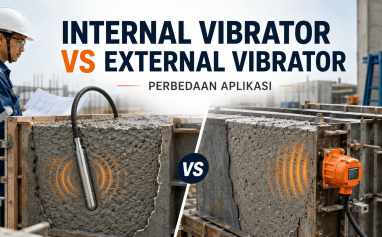
Before discussing misuse, it is important to make sure the method of vibration chosen is appropriate. If you still differentiate Internal Vibrator vs External Vibrator, the special comparison article on the topic should be a reference first. Link Production has not been inserted because the URL of the Comparison article cannot be verified.
This article is also not an operating manual. Duration, distance, pattern, penetration, withdrawal, frequency, and configuration of use must follow the concrete mix, geometry, reinforcement, project statement method, and technical documentation of the tools used.
In This Article
Why can't use a concrete vibrator how to use a concrete?
Concrete Consolidation does not take place under identical conditions in each project.
ACI calls mixed workability and placing condition as part of the basis for choosing the consolidation method. In actual work, the geometry of elements, reinforcement, formwork, worker access, types of vibrator, power source, and placement methods also need to be understood together.
Therefore, operator experience remains important, but should not stand alone as the only basis.
For example, work in areas with relatively open reinforcement can have different access conditions than areas with solid reinforcement. Likewise, work with internal vibration cannot be treated the same as external vibration which transmits energy through formwork.
The principle:
Job requirements → consolidation method → equipment → statement method → usage according to documentation
no :
Tools available → Use with the usual pattern.
Error 1: Using the type of vibrator that is not suitable for the application
The first error may appear even before the tool is operated: the vibration method selected does not match the working conditions.
The internal vibrator applies the vibration directly to the fresh concrete through the vibrating head, while the external vibrator transmits the vibration through the formwork, mold, or the structure to which the unit is installed. Wacker Neuson also distinguishes the two as two concrete consolidation systems with different configurations and applications.
Therefore, do not impose a method just because the unit is currently available.
Consider among others:
- element shape;
- Concrete Mix;
- Reinforcement;
- access to concrete;
- formwork or mold;
- power source;
- Casting workflow;
- Technical Documentation Tool.
The new model or method can be evaluated after the job requirements are clear enough.
Error 2: Using one vibration pattern for all concrete elements
Slab, Wall, Column, Beam, Mold Precast, and Area with Dense Reinforcement can present different access and geometry conditions.
But the name of the element alone is also not enough to determine how the vibration should be done.
For example, two wall concrete can be different on:
- thickness;
- Reinforcement Arrangement;
- opening;
- formwork;
- Concrete Mix;
- Placing Sequence;
- Access Point.
Therefore:
Geometry and working conditions need to be checked with concrete mix, reinforcement, formwork, and method statement.
Taking one pattern from the previous project then using it without reviewing on new jobs risks ignoring the difference.
Error 3: Inadequate vibration or under-vibration
The purpose of consolidation is to remove the entrapped water from the newly placed concrete. If the vibrational energy or coverage is inadequate, the consolidation process may not have reached the job requirements.
Under-vibration can be related to several conditions, for example:
- Areas not covered;
- Some concrete placements are missed;
- Access to certain areas is limited;
- inconsistent workflow;
- equipment does not match the application;
- or the method of use does not follow the requirements of the job.
However, the symptoms of concrete should not be used automatically as a single diagnosis that the cause must be under-vibration. Concrete mix, formwork, placing practice, leakage, reinforcement, and other factors can also have an effect.
Use Wording:
“Can be an indication that needs to be checked”
no :
“It must be caused by under-vibration.”
Error 4: Assuming the longer the vibration is always the better
The next error is in the opposite direction.
If too little vibration can result in inadequate consolidation, this does not mean that the vibration time must be extended.
Wacker Neuson explicitly suggested that the internal vibrator should not be left too long at one point because it can increase the risk of segregation.
A more precise principle is:
enough to meet the needs of consolidation, not as long as possible.
Concrete mix also affects the response to vibration. Manufacturers even offer systems with different characteristics based on application conditions, indicating that frequency or operating characteristics should not be read separately from the concrete conditions.
Therefore this article does not give the number “x seconds per point”.
These parameters must come from the statement method, concrete specifications, or technical guidance that are relevant to work conditions.
Error 5: Coverage and unplanned work sequence
Concrete vibrator is not a randomly used tool in the foundry area.
Coverage needs to be part of the workflow planning so that no area is accidentally missed or gets an inconsistent treatment pattern.
Wacker Neuson emphasizes regular immersion point transfer when using internal vibrator. ACI also discusses consolidation as a part that must be coordinated with concrete placement, including work with certain lifts or layers.
What to think about is:
- Concrete Placement Order;
- areas to be reached;
- Geometry;
- layer change;
- Reinforcement;
- number of workers;
- tool availability;
- Coordination between the Placing Crew and the Consolidation Crew.
This article does not specify a specific spacing because the need is not universal.
Error 6: Using a vibrator to replace the concrete removal process
Placing Concrete and Consolidating Concrete not the same function.
Aci suggested that the concrete be placed as close to its final position as possible and explicitly warned that the vibrator is not used to move the concrete pile to another position, because excessive transfer through the vibration can cause poor segregation and consolidation.
The multiquip manual also provides similar prohibitions on certain models: the vibrator is not used to move the concrete laterally.
Therefore, if the material must be distributed to other areas, the problem needs to be reviewed on the Placing Method, is not resolved by making the vibrator as a substitute for the placement tool or method.
Error 7: Ignoring Reinforcement, Formwork, and Hard-Reach Areas
Dense reinforcement and complex geometry can change access to concrete placement.
The error to avoid is forcing the vibrating head into areas that do not have the appropriate clearance, or using the assumption that the same head and configuration are definitely suitable for all parts of the work.
Wacker Neuson provides internal vibrator in various systems and configurations, including high-frequency and flex-shaft, which shows that application needs are not always the same.
What needs to be done at the planning stage is to evaluate:
Access → Concrete Geometry → Reinforcement → Candidate Equipment → Documentation
Not modifying reinforcement or forcing the tool into an inappropriate area.
Error 8: External vibrator is installed without regard to the mounting system
In external vibration, mounting is not just a place to hang a motorbike.
Vibration needs to be transmitted through formwork or mold, so that fastening becomes part of the system. Wacker Neuson even offers a fastening system as part of an external vibrator solution.
An error can occur if the user only sees the external motor vibrator but ignores:
- formwork;
- Mounting surface;
- fastening;
- Geometry;
- distribution vibration;
- operating voltage;
- Engineering Requirements.
This article does not provide instructions on brackets, welding, bolt configuration, or electrical installation.
All of these details must follow the technical documentation and engineering review for the system used.
Error 9: Ignoring the condition of the tool before and during use
Misuse errors do not always come from the concrete consolidation technique. Equipment conditions can also change.
that can be observed visually or through behavioral changes include:
- cable or connector damage;
- Hose or shaft that looks abnormal;
- broken housing;
- components look loose;
- changes in the pattern of vibration;
- new voice;
- unusual heat;
- or the output is changed.
The multiquip vibrator manual, for example, requires the condition of the unit to be checked and reminding that the equipment should be used by trained personnel and according to the manual.
Distinguish:
Observation → examination → diagnosis → improvement
Operators can observe changes. The cause should not be confirmed immediately without examination.
If there is an abnormal change in conditions, the principle of the article Construction equipment signs need to be checked Also applicable: changes in sound, vibration, temperature, indicator, cable, mounting, or work results are the reason for conducting a review, but not the diagnosis of certain components. The production page does distinguish observation, examination, and diagnosis.
If the condition poses a risk or the tool exhibits abnormal behavior, follow the project procedures and manufacturer manuals and direct the inspection to competent personnel.
Error 10: Ignoring the Manufacturer's Manual and Project Statement Method
Not all concrete vibrators have the same design, source power, head, converter, control, and application.
Even in one brand there are several internal vibrator systems with different configurations.
Therefore the hierarchy of more precise use is:
Requirements Job + Statement Method + Tool Manual + Competent Personnel
no :
operator habits.
Manuals can also have model-specific limitations. For example, a particular multiquip manual provides special provisions for the vibrator head that does not apply automatically to all concrete vibrators.
That is the reason educational articles like this should not publish a single universal number.
Checklist before use is evaluated
The following checklist is not a start-up procedure. Its function helps supervisors, site engineers, or project teams to see if the basic data is sufficient.
| Inspection | question | Status |
|---|---|---|
| Vibration Method | internal/external already determined based on application? | Confirmed / Need Confirmation |
| Concrete Mix | relevant data available? | Confirmed / Need Confirmation |
| geometry | Have you understood the form and area of work? | Confirmed / Need Confirmation |
| Reinforcement | Have you checked the access and arrangement? | Confirmed / Need Confirmation |
| Formwork/Mould | according to the planned method? | Confirmed / Need Confirmation |
| Concrete Placement | Have the work sequences been coordinated? | Confirmed / Need Confirmation |
| equipment | Visual conditions do not show abnormal changes? | Confirmed / Need Inspection |
| Power System | according to candidate technical data? | Confirmed / Need Confirmation |
| Manual | Manual model available? | Available / Missing |
| STATEMENT METHOD | Project documents available? | Available / Need Confirmation |
| Operator | competence/authorization according to project requirements? | Confirmed / Need Confirmation |
| Work Area | Have you established coordination between workers? | Confirmed / Need Confirmation |
Status Need Confirmation This does not mean that equipment cannot be used. This means that the data is not enough to make a decision.
If the problem is not a vibration technique but the selection of tools
Some of the actual usage problems can start earlier, namely when the tool requirements are not well defined.
For example:
- The type of vibration method is not clear;
- source power is not suitable;
- head or configuration has not been checked;
- External mounting is not taken into account;
- Concrete application is different from the initial assumption;
- The number of work areas is unknown.
If the need needs to be rearranged, use RFQ Checklist for Construction Equipment To separate functions, applications, specifications, quantity, power source, working conditions, and supporting data before the product candidate is compared.
The RFQ article has become the production page of Agung Rejeki and serves as the initial framework for preparing requirements.
FAQ
What are the most common mistakes when using Concrete Vibrator?
The error can be in the form of choosing an inappropriate method, inadequate coverage, excessive use, ignoring reinforcement or formwork, using a vibrator to move concrete, and ignoring the condition of the equipment and technical documentation.
Is the vibration the longer it always gets better?
No. The need for vibration is to achieve the appropriate consolidation, not using a vibrator as long as possible. Wacker Neuson warned that too long vibration at one point could increase the risk of segregation.
What is meant by under-vibration?
In the context of this article, under-vibration means vibration that does not provide adequate consolidation to the work area. The specific cause should still be examined and cannot be determined only of one symptom.
What is meant by over-vibration?
over -Vibration refers to the use of vibrations that exceed the needs of the job. The effect needs to be assessed based on concrete mix, method, and placement conditions; do not use one universal duration as a limit.
Is there a vibration duration that applies to all jobs?
No universal numbers are used in this article. Duration must follow concrete mix, geometry, reinforcement, method statement, and related technical guidelines.
Is the vibration point distance always the same?
It should not be assumed to be the same for all jobs. Coverage depends on equipment, concrete, geometry, reinforcement, and methods used.
Can concrete vibrator be used to move concrete?
The vibrator is not a substitute for the placing method. ACI suggests that the concrete is placed as close to the final position as possible and not moved from the stack using a vibrator because it can cause segregation and poor consolidation.
Why Reinforcement and Formwork Need to Be Pay Attention to?
Both affect Access, Geometry, and how vibration is applied or transmitted. This is very important for both internal and external vibration.
What to do if the vibrator is felt or sounded abnormal?
These changes need to be recorded and checked based on the manual and project procedures. Do not immediately diagnose the cause or disassemble.
Do internal and external vibrators have the same usage error?
Some principles are the same, but not entirely. External vibration has a big dependence on formwork and fastening system, while internal vibration works directly on concrete.
Does this article replace the manufacturer's manual?
No. The model manual, project statement method, and competent personnel instructions remain the main operational source.
What data should be prepared when you want to re-evaluate the need for tools?
Prepare the type of work, concrete mix, geometry, reinforcement, formwork, vibration method, energy source, number of work areas, work targets, and available technical documents.
Conclusion
Error using Concrete Vibrator It doesn't always start when the device is turned on. Errors can start from choosing inappropriate methods, incomplete requirements, unplanned coverage, overuse, or neglected equipment conditions.
Internal and external vibration have different applications and system requirements. The technique of its use must also adjust the concrete mix, geometry, reinforcement, formwork, placing methods, and project documentation.
There is not a single number of duration, spacing, frequency, or pattern that deserves to be treated as a universal rule for the entire project.
Still need to review the need for vibrator for concrete work?
Each project can have different conditions in terms of concrete elements, formwork, reinforcement, access, casting methods, power sources, and types of vibrators used.
If the requirements for tools or methods that need to be evaluated are not clear, prepare the available job data so that the initial parameters can be reviewed before the product or quotation candidate is determined.
Haven't prepared requirements yet? use RFQ Checklist for Construction Equipment as a guide for initial data.
The suitability of the method, model, configuration, capacity, price, stock, schedule, accessories, and service availability still needs to be verified based on project requirements and related product data.
The production consultation page is available as a service destination; but the explicit service-eligibility registry still needs to be checked before publishing the gate is declared ready.









Add comment
You must be logged in to post a comment.