



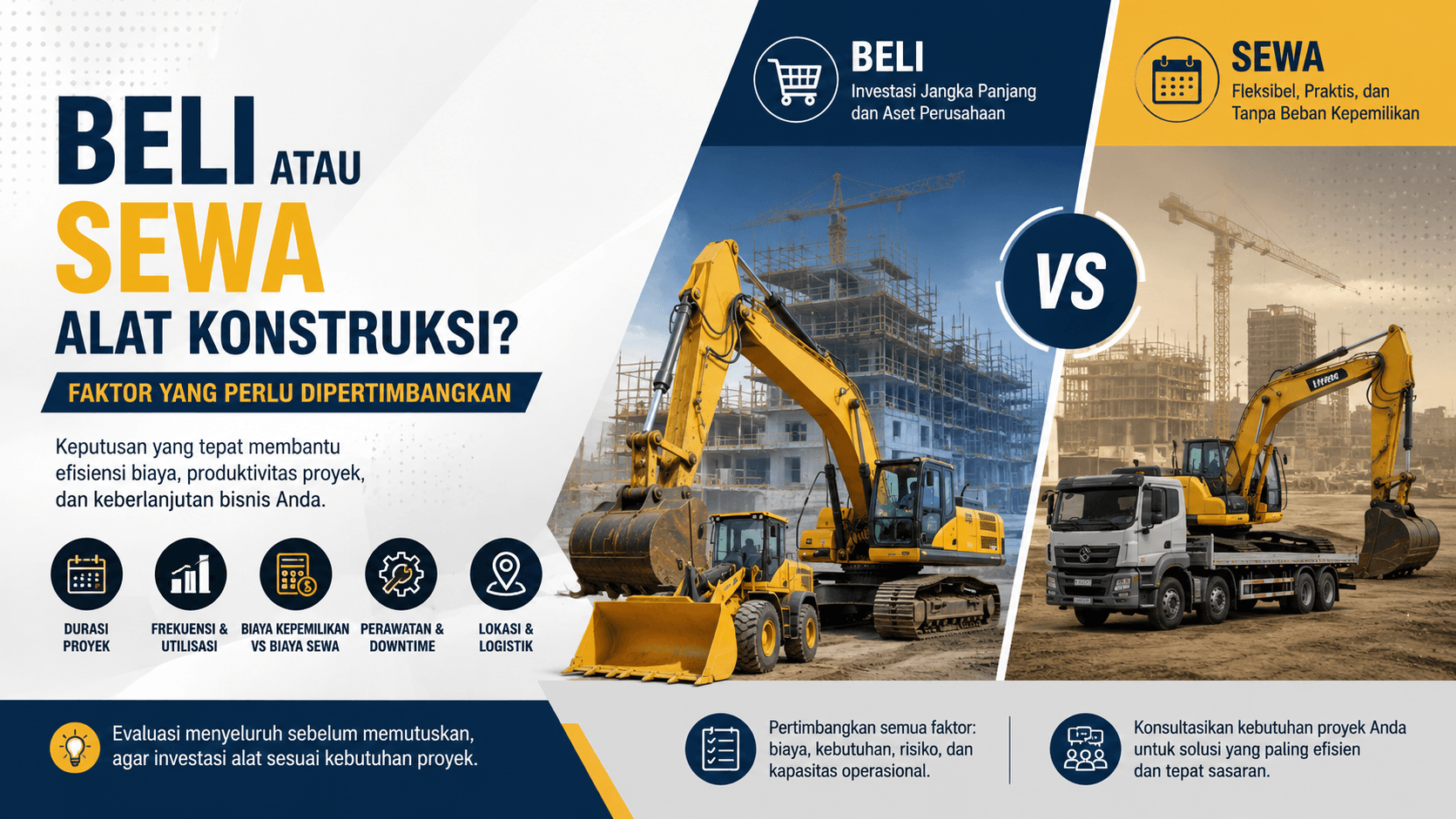
Buy or Rent Construction Equipment? Factors to Consider – Selecting Buy or rent construction equipment This question cannot be answered simply by comparing purchase prices and rental rates. The right decision depends on the duration of use, frequency of operation, utilization rate, cash flow situation, technical requirements, project location, downtime risk, and the company’s ability to manage the equipment as an asset.
The life-cycle cost approach is also used in Indonesia’s procurement guidelines. In this context, the evaluation may take into account the price, operating costs, maintenance costs, and residual value over the operational period—not just the initial price.
In general, purchasing tends to be more appropriate when equipment will be used repeatedly, utilization rates are high, technical requirements are relatively stable, and the company is capable of handling operators, maintenance, storage, and asset management. Conversely, renting tends to be more flexible for short-term projects, seasonal needs, specialized equipment that is rarely used, or situations where project specifications and locations change frequently. Considerations regarding duration, frequency of use, maintenance, storage, specialized equipment, and project location also feature in manufacturers’ guidelines regarding the decision to buy or rent.
However, “tend to” does not mean a definitive decision. Before making a choice, the company needs to calculate the total cost of use and assess the operational risks of both options.
In This Article
Quick summary: When should you buy versus rent?
Tend to buy
A purchase may be more relevant if:
- equipment used over the long term;
- repeated use across multiple projects;
- The utilization rate is expected to be high and stable;
- The required specifications remain relatively constant;
- The company has operators;
- maintenance teams or partners are available;
- Storage space and a security system are available;
- Owning the equipment provides better control over the work schedule.
Tends to rent
Rental may be more relevant if:
- needs that are limited to a specific job or period;
- the project has a limited duration;
- The equipment required is very specialized;
- Capacity requirements may change;
- the project site is far from the operational base;
- The company wants to preserve its working capital;
- The company is not yet ready to handle maintenance and storage;
- The equipment is needed as a temporary supplement while several projects are underway simultaneously.
Further analysis is needed
Additional analysis is required if the project duration is long but daily usage is low, the requirements for the next project are uncertain, mobilization costs are high, or equipment specifications may change in subsequent phases of the work.
Key factors in decision-making
1. Project duration and frequency of use
Project duration is a starting point, but it is not the only factor to consider. Equipment needed for a year may not be worth purchasing if it is only used a few days each month. Conversely, equipment used on a relatively short-term project may be worth purchasing if it can be immediately reassigned to another project once the current one is completed.
Count the actual number of working days or hours, not just the contract duration. Take into account the time equipment is idle due to waiting for work, location changes, weather, inspections, schedule changes, or project coordination.
2. Utilization Rate
Utilization indicates how often a piece of equipment actually performs work compared to the time it is available. The higher and more consistent the utilization, the greater the chance that ownership costs will be spread over more productive hours or days.
Low utilization means that equipment continues to incur costs for storage, security, depreciation, and maintenance even when it is not in use. Needs assessments should be based on realistic schedules, rather than the assumption that the equipment will always be in use.
Productivity, availability, operating costs, utilization, resale value, financing, and acquisition cost are some of the factors that can affect the total cost of equipment ownership.
3. Certainty regarding the next project
Purchases are easier to justify when there is a clear project pipeline. Companies need to assess whether equipment with the same functions, capacity, and configuration will still be needed once the project is completed.
Don’t assume that all projects require the exact same equipment. Differences in capacity, dimensions, power source, accessories, site conditions, or bid requirements can make the equipment you purchase less suitable for your next job.
4. Initial investment, cash flow, and capital allocation
A purchase requires an upfront expense or a financing commitment. Its impact must be weighed against other capital requirements, such as labor, materials, inventory, vehicles, project guarantees, and operating costs.
Renting typically reduces the initial investment required, but still entails payment obligations throughout the lease term. Renting may also involve a security deposit, mobilization fees, overtime charges, operator fees, and other additional costs.
Decisions should be based on the project’s cash flow patterns and the opportunity cost of capital, not just the initial outlay. The European Rental Association notes that ownership can tie up capital and incur ongoing costs, while renting converts some fixed costs into costs that are more closely tied to the period of use. The context of this source is international and does not reflect local pricing conditions.
5. Maintenance, repairs, and downtime
Equipment owners are responsible for ensuring that:
- maintenance schedule;
- availability of spare parts;
- technician or service partner;
- work equipment;
- service notes;
- inspection;
- repair budget;
- breakdown response plan.
Delays in maintenance can increase the risk of damage and downtime.
In a rental arrangement, the division of maintenance responsibilities and repair Be sure to read the quotation or agreement. Not all damage is automatically the provider’s responsibility. Damage resulting from operation, on-site conditions, use outside of specifications, or negligence may be handled differently.
Downtime must also be considered a cost. When equipment stops running, the consequences can include idle labor, delays in subsequent work, changes to the work sequence, contractual penalties, or disruption to project targets.
6. Availability of operators
Operator availability should not be taken for granted. Companies need to ensure:
- Who operates the equipment;
- required competencies;
- work schedules and shifts;
- accommodations and transportation;
- operational oversight;
- On-site safety coordination.
In a rental agreement, an operator may be included, excluded, or offered as a separate component. The scope must be confirmed, including working hours, overtime, operator changes, expenses, housing, and responsibilities while on the project.
7. Storage, Security, and Asset Management
Personal equipment requires appropriate storage, security measures, record-keeping of its location, inspections when not in use, and protection against the weather, loss, vandalism, or unauthorized use.
A company’s ability to manage assets also includes:
- recording of working hours;
- maintenance and repair history;
- cost per unit;
- unit location;
- cross-project use;
- proof of ownership;
- insurance;
- decision to refurbish or dispose of an asset.
ISO 55001 incorporates costs, performance, risks, data, and operations throughout the entire lifecycle as part of a structured approach to asset management.
8. Transportation, Mobilization, and Demobilization
Equipment relocation costs can be a significant expense, especially for heavy equipment, large-scale equipment, or equipment that requires a specialized fleet.
Factors to consider include:
- origin unit;
- shipping distance;
- road access;
- weight and dimensions;
- load limit;
- fleet type;
- licensing;
- escort;
- loading and unloading;
- assistive devices;
- site access conditions;
- the need for redeployment.
When making a purchase, the initial shipping cost isn’t the only transportation expense. The equipment may need to be moved between locations throughout its useful life.
For rentals, mobilization and demobilization fees may be calculated separately from the rental rate. An example from Cat Rental Store’s public terms and conditions also states that taxes, shipping, handling, surcharges, and delivery may be excluded from the displayed rates, and that the final price and terms must be agreed upon at the time of the contract. This is provided solely to highlight the importance of reviewing the scope of the quotation and is not intended to reflect Agung Rejeki’s rental policy.
9. Depreciation and Resale Value
Purchased equipment may have resale value, but its value is influenced by:
- age;
- working hours;
- physical and operational conditions;
- medical history;
- document completeness;
- market demand;
- unit configuration;
- availability of replacement parts.
Resale value estimates should be made conservatively. Do not treat future resale value as a certainty, especially when there is no comparable market data for the same model, year, condition, and configuration.
10. Compliance with specifications and flexibility
The decision to buy or rent can only be compared once the technical requirements have been defined. Parameters may include:
- function of the device;
- capacity;
- duty cycle;
- dimensions;
- power source;
- pressure, flow rate, or output;
- accessories;
- working conditions;
- space limit;
- safety requirements;
- technical documents.
Renting provides the flexibility to switch models or capacities for different projects. However, such changes can only be made if a suitable unit is available and the terms are agreed upon.
Purchasing gives you control over your own units, but the risk of incorrect specifications is greater because the commitment is longer-term.
11. Schedule, project location, and bid documents
Projects with multiple locations require an equipment distribution plan. Moving a piece of company-owned equipment from one project to another can cause scheduling conflicts and incur additional costs.
Local rentals may reduce travel distances, but the availability and terms of the provider must still be confirmed.
For the project tender, check whether the document requires:
- proof of ownership or possession of the equipment;
- letter of support;
- a lease agreement or contract;
- list of equipment;
- inspection record;
- certificate;
- technical data;
- evidence of the operator's readiness;
- commitment to the mobilization schedule.
The requirements for each tender may vary. The applicable selection documents should be the primary source of information.
A Comparison of Buying and Renting
| Factors | Buy | Rent | Questions that need to be answered |
|---|---|---|---|
| Duration of use | More relevant for long-term and recurring needs | More flexible for limited needs | How long does the device actually work? |
| Utilization | Costs can be spread out when usage is high | Payments are based on the rental period | How many days or hours of actual use? |
| Initial capital | Requires a purchase or financing | It is generally milder at the beginning of use | Is capital required for other activities? |
| Maintenance | Owned and managed by the owner | Depending on the division of responsibilities in the agreement | Who is responsible for service and repairs? |
| Downtime | The owner arranges for repairs and replacement units | Support or replacement depends on the agreement | What's the plan if the equipment stops working? |
| Operator | Must be provided or recruited | Can be included or separate | Are the operators available and competent? |
| Storage | Requires space and security measures | No storage is required after the unit is returned | Is there sufficient yard space available? |
| Mobilization | Expenses Incurred During the Transfer of Assets | Generally calculated per shipment or as specified in the contract | How many locations are there, and what is the distance between them? |
| Depreciation | Taking on the risks of ownership | Does not become the tenant's asset | What is a realistic estimate of the resale value? |
| Specification flexibility | Limited to units owned | Can be customized if the unit is available | Will the capacity of the next project change? |
| Spare parts | The owner manages procurement and inventory | Depending on the service provider | How is the support for parts and technicians? |
| Asset Management | Requires record-keeping, maintenance, insurance, and disposal | Focus on the lease agreement and usage | Is the company ready to manage its assets? |
| Bid | Can provide proof of ownership upon request | Can serve as proof of receipt when the document is received | What documents are required for the tender? |
Understanding the total cost of ownership
Total cost of ownership or TCO is an approach that considers the total costs over the entire lifecycle of a piece of equipment, not just the purchase price.
The European Rental Association’s guidelines break down the TCO factors for equipment into three main phases: acquisition, operation and maintenance, and asset disposal. In the context of procurement in Indonesia, costs over the economic life of an asset may also include the purchase price, operating costs, maintenance costs, and residual value.
The educational framework can be described as follows:
Total purchase cost = acquisition cost + operating costs + ownership costs − estimated resale value.
Total rental cost = rental rate + mobilization + demobilization + operating costs + additional costs.
This formula is not a substitute for a quote or a detailed financial analysis. Each component must be based on actual data regarding the equipment, location, duration, working conditions, and the provider’s policies.
Costs that are often overlooked when making a purchase
In addition to the acquisition cost, a purchase may involve:
- tax;
- financing;
- shipping costs;
- loading and unloading;
- commissioning;
- preliminary testing;
- operator;
- Fuel or energy;
- routine maintenance;
- spare parts;
- repair;
- storage;
- security;
- insurance;
- depreciation;
- asset management;
- disposal or resale costs.
Indirect costs are also important, such as the time the team spends managing maintenance, parts inventory, lost productivity during downtime, and the risk of equipment sitting idle due to changes in the project schedule. Total cost of ownership and operation can indeed extend beyond the price of the machine, including financing, taxes, labor, fuel, maintenance, replacement parts, overhead, downtime, and disposal value.
Costs That Are Often Overlooked When Renting
The rental rate may not cover all expenses. Additional costs may include:
- mobilization;
- demobilization;
- operator;
- Fuel or energy;
- deposit;
- overtime;
- accessories;
- minimum lease term;
- insurance;
- damage costs;
- cleaning costs;
- delayed return;
- lease extension;
- Costs based on location and working conditions.
Request written details regarding the scope of the package, the rental period, operating hours, liability for damage, breakdown procedures, and additional fees. All actual components must be confirmed in the quotation or agreement.
Use Cases
| Scenario | Decision-making tendencies | Reason | Data that still needs to be calculated |
|---|---|---|---|
| A short-term project with limited use | Tends to rent | Reducing asset commitments for temporary needs | Rates, minimum rental period, mobilization, operator, and extension risk |
| Long-term projects with high utilization rates | Tend to buy | The cost of ownership could be spread out over many productive hours | Acquisition cost, financing, maintenance, downtime, and resale value |
| Specialized tools that are used only occasionally | Tends to rent | Avoiding having specialized equipment sit idle after the job is done | Availability, accessories, technical compatibility, and mobilization and demobilization |
| Companies with recurring projects and their own maintenance teams | Tend to buy | The company has the capability to operate and maintain its assets | Project pipeline, utilization, parts, workshop capacity, and fleet costs |
| It's a long-term project, but the specifications are subject to change | Further analysis is needed | Duration supports the purchase, but the risk of incorrect specifications is high | Project phases, capacity for each phase, replacement costs, and combination options |
| Many projects in remote locations | Further analysis is needed | Ownership provides control, but transfers can be costly | Schedule, location, transportation costs, local rentals, and downtime |
Checklist for Deciding Whether to Buy or Rent
- How long will the device be used?
- How many days or hours of use per month?
- Will this requirement recur in the next project?
- Is there a suitable operator available?
- Is there secure storage available?
- Is the company capable of handling maintenance and repairs?
- How much do mobilization and demobilization cost?
- Are the specifications or capacities subject to change?
- Does the project require specific ownership or lease documents?
- What are the consequences if the equipment experiences downtime?
- Is the capital needed more for other activities?
- Are replacement parts and technicians available?
- How is resale value estimated?
- Are the two options being compared based on equivalent specifications and package scope?
Common mistakes when comparing
The first mistake is comparing the purchase price to the rental rate without factoring in other costs.
The second mistake is comparing different tools in terms of:
- capacity;
- class;
- condition;
- year;
- accessories;
- working hours;
- configuration;
- package scope.
Another common mistake is assuming that maintenance, operators, fuel, mobilization, insurance, or damage are always included in the rental price.
Other mistakes include using contract duration as a substitute for actual utilization, ignoring downtime, and being overly optimistic about follow-on projects and resale value.
A low initial price does not automatically result in the lowest total cost. Conversely, a lease that appears flexible is not necessarily cheaper for long-term use. A life-cycle cost analysis helps procurement teams compare options that meet technical requirements on a more comprehensive cost basis.
FAQ
1. When does it make more sense to buy equipment?
Purchasing tends to make more sense when usage is high and recurring, technical requirements are stable, the scope of the project is clear, and the company is prepared to provide operators, maintenance, storage, and asset management. The decision still needs to be supported by a TCO calculation.
2. When is renting more flexible?
Renting tends to be more flexible for short-term projects, seasonal needs, specialized jobs, remote locations, or situations where the model and capacity may change. The actual flexibility depends on availability and the provider’s terms.
3. Is renting always cheaper?
No. Renting can reduce the initial investment and ownership costs, but the total cost is influenced by the duration, rate, minimum rental period, mobilization, operator, overtime, and additional fees. For high-volume and long-term use, purchasing may be a better option once all costs are factored in.
4. What expenses are often overlooked?
When making a purchase, costs that are often overlooked include financing, maintenance, parts, storage, insurance, downtime, and asset disposal.
When renting a vehicle, costs that are often overlooked include mobilization, demobilization, deposits, operator fees, fuel, overtime, accessories, rental extensions, and damage charges.
5. How do you calculate the break-even point for buying versus renting?
Set the same analysis period, use equipment with equivalent specifications and coverage, and then compare the total accumulated purchase costs with the total rental costs.
The break-even point occurs when the two totals approach the same value. Do not set general numbers, percentages, or time periods without actual data.
6. Do operators typically include rental fees?
This cannot be assumed. Operators may be included, offered separately, or must be provided by the tenant.
Confirm the scope of the operator’s duties, working hours, overtime, transportation, accommodations, and responsibilities in the quotation or agreement.
What if the specifications for the next project are different?
Changing needs increase the risk of suboptimal asset utilization. Consider renting, a combination of ownership and rental, or purchasing core equipment with the appropriate accessories.
Each option must still be verified against the project's technical requirements.
Conclusion
There is no single answer to the question of whether to buy or rent equipment construction. The best option is the one that best aligns with the duration, utilization, cash flow, technical requirements, operational risks, project location, and the company’s ability to manage the equipment.
Don’t stop at the initial price. Compare total costs, scope of services, downtime risks, flexibility, and future project needs using comparable data.
Discuss the project duration, equipment specifications, location of use, and your usage patterns so that the decision between buying and renting can be evaluated more accurately.







Add comment
You must be logged in to post a comment.