



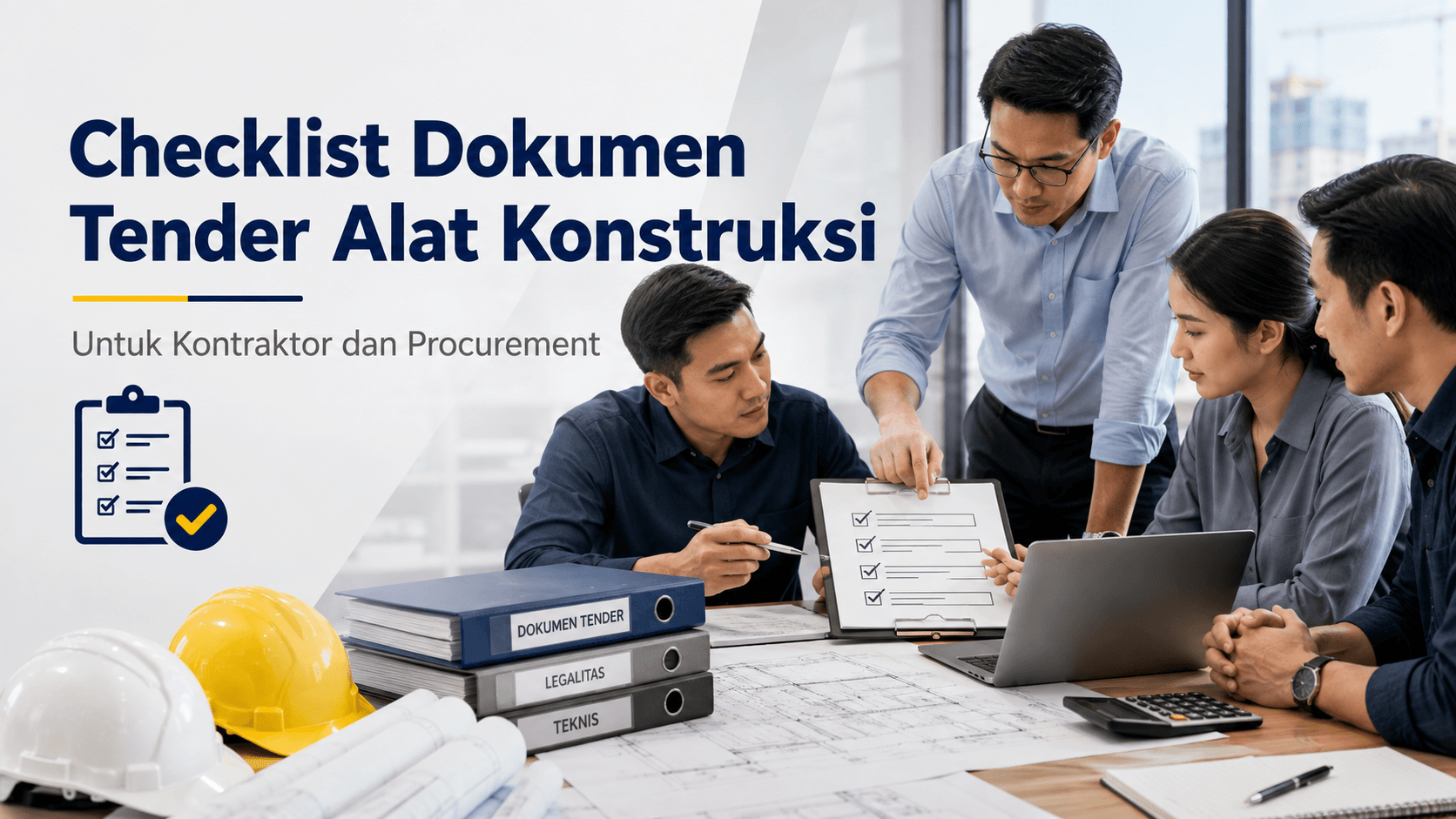
Construction Equipment Bid Document Checklist for Contractors and Procurement – When participating in a construction equipment tender, it is not enough to simply prepare a price quote and product brochures. The contractor, procurement, estimator, and tender administration teams must ensure that the company’s documents, technical specifications, price forms, supporting documentation for the products, and shipping terms are all consistent with one another.
Minor errors—such as discrepancies in model names between the proposal and the datasheet, expired document validity periods, unsigned forms, or specifications that do not meet the tender requirements—can lead to requests for additional clarification or even render the proposal ineligible for evaluation.
By using Checklist of Construction Equipment Bid Documents, the team can categorize documents into administrative, qualification, technical, commercial, and supporting documents. This checklist does not replace the selection documents or official tender instructions. Each package may have different formats and requirements; therefore, the tender documents, addenda, and official clarification results remain the primary reference.
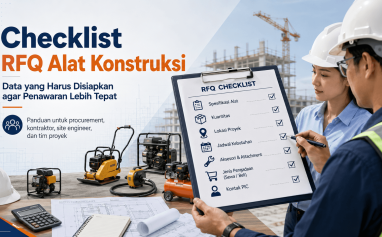
If the equipment requirements, specifications, quantities, condition, and scope of the bid have not yet been clearly defined, the procurement team can use the guidelines RFQ Checklist for Construction Equipment first. Complete RFQ information will facilitate the review of technical documents, the preparation of quotations, and the alignment with tender requirements.
In This Article
Why Is It Important to Check the Completeness of Tender Documents from the Very Beginning?
Construction equipment bid documents typically involve several departments within a company at once:
- tender or business development team;
- procurement;
- technical team;
- estimator;
- finance and tax;
- legal or corporate administrative matters;
- supplier or product owner;
- logistics team;
- a signatory who is a supervisor or an authorized representative.
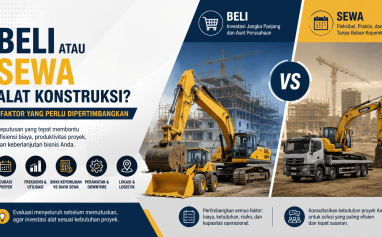
The tender should also clarify whether equipment needs will be met through purchase or rental. Before determining the bidding scheme, the team can examine the factors involved in Deciding Whether to Buy or Rent Construction Equipment, including duration of use, utilization rate, operating costs, mobilization, maintenance, and the risk of downtime.
If new documents are submitted close to the submission deadline, the risk of non-compliance increases. The team may not have had time to verify whether the product specifications actually meet the requirements, whether the supporting documents refer to the same product, or whether the price includes the requested components.
In official government procurement documents, bids are also divided into administrative, technical, pricing, and qualification sections. This division indicates that the completeness of one section does not automatically compensate for deficiencies in another.
Therefore, the review of the documents should begin as soon as the bid documents are received, not just a few hours before the deadline.
Start with the Tender Documents, Not the Old Template
Before gathering company documents or requesting equipment quotes, be sure to read the entire tender document first.
Check at least the following:
- package name and number;
- scope of needs;
- tender schedule;
- submission deadline;
- method of delivery;
- file format;
- administrative requirements;
- qualification requirements;
- technical specifications;
- bill of quantities;
- price form;
- tax provisions;
- the required collateral;
- the offer's validity period;
- Shipping terms;
- warranty terms;
- draft contract;
- addendum or amendment to a document;
- the result of providing an official explanation or clarification.
Do not simply use files from a previous tender without comparing them to the documents for the tender you are currently participating in. The tender name, designated official, bidding period, specifications, number of units, form formats, and contract terms may differ.
For government procurement, the regulatory framework has undergone a second revision through Presidential Regulation No. 46 of 2025. The LKPP has also issued a consolidated document and guidelines for the transition period. Therefore, the team needs to review the applicable provisions and document templates for the contract package when preparing the bid.
Key Checklist for Construction Equipment Bid Documents
Not all of the documents listed below are required for every tender. Use the selection documents as the final determining factor.
| Group | Documents or information | Primary Examination | General Status |
|---|---|---|---|
| Reference documents | Bidding documents, RFPs, ITTs, or requests for proposals | Be sure to use the latest version | Must be checked |
| Reference documents | Addendum and Results of the Explanation | Make a note of any changes to specifications, schedules, or forms | If published |
| Administration | Letter of Offer | Package name, date, validity period, value, and signatory | Commonly requested |
| Administration | Power of Attorney | Authorized representative in accordance with the company's authority | If authorized |
| Administration | Articles of Incorporation and Amendments | The company name, management, and authority remain unchanged | If required |
| Administration | NIB and business license | Business activities based on package requirements | If required |
| Administration | Tax documents | Tax status and information as specified in the package | If required |
| Qualifications | Company Information Form | All columns are consistent with the legal document | Commonly requested |
| Qualifications | Work Experience | Relevance, value, time frame, and supporting evidence | If required |
| Qualifications | Performance evaluation or performance history | Check the availability of data in the specified system | If required |
| Technical | Compliance Sheet | Each requirement is addressed separately | Highly recommended |
| Technical | Product Specifications | Based on datasheets, catalogs, or official documents | Required if the device is offered |
| Technical | Brand and model | The writing style must be consistent throughout the document | Required if specified |
| Technical | Brochure or datasheet | The document must conform to the provided template | Commonly requested |
| Technical | Images and dimensions | Use as needed to verify a room or application | Depends on the tender |
| Technical | List of Accessories | Separate standard, optional, and excluded items | Highly recommended |
| Technical | Number and capacity | In accordance with the bill of quantities and specifications | Required |
| Technical | Proof of ownership or support for the device | The identity of the equipment and the supporting parties must be clear | If required |
| Technical | Letter of Support | Products, models, quantities, projects, and validity periods are consistent | If required |
| Technical | Warranty Statement | Warranty provider, duration, coverage, and exclusions | If required |
| Technical | Certificates or standards | Certificates must be relevant to the product and still valid | If required |
| Commercial | Price List | Item, quantity, unit, unit price, and total | Commonly requested |
| Commercial | Tax base | Explain whether the VAT is included or not, based on the form | This must be clarified |
| Commercial | Shipping and Logistics | Please specify whether it is included or not, as well as the shipping address | This must be clarified |
| Commercial | Offer validity period | Must not be shorter than the requirement | Commonly requested |
| Commercial | Shipping Schedule | Based on confirmed information | If required |
| Commercial | Payment Terms | Must comply with the tender documents or the results of the clarification | If required |
| Guarantee | Bid or Performance Bond | Issuer, value, form, and validity period | If required |
| Presentation | File name and format | Follow the required upload structure and format | Must be checked |
| Presentation | Signature or stamp | Use as directed in the documentation | If required |
| Presentation | Upload Deadline | Allow time for the uploaded results to be verified | Required |
Company Administrative and Qualification Documents
Administrative documents verify the company’s identity and authority to submit a bid. Qualification documents help the organizing body assess the participants’ capabilities and eligibility.
In one of LKPP’s official document templates, the administrative and technical qualification requirements include, among other things, compliance with business regulations, tax status, articles of incorporation and any amendments thereto, as well as the legal capacity to enter into a contract. However, the final details of the requirements are still subject to the Selection Data Sheet or a similar section in the tender being participated in.
Check the following consistency:
- business entity name;
- type of business entity;
- address;
- business identification number;
- the name of the director or officer;
- signing authority;
- account information;
- tax data;
- email address;
- phone number;
- experience data;
- Information regarding staff or personnel, if requested.
A one-letter typo in a company’s name may seem minor, but it can raise questions if it differs from the articles of incorporation, NIB, proposal letter, or qualification form.
Brief Administrative Checklist
- The company name is consistent.
- The package name and tender number are correct.
- The signatory has the authority.
- A power of attorney is available when the signatory is authorized to act on behalf of another.
- The legal documents are still valid.
- Tax documents in accordance with the requirements.
- All the forms have been filled out.
- The date and validity period have been verified.
- No pages were left out.
- The file can be opened and read.
Technical Documents for Construction Equipment
The technical section should demonstrate that the equipment being offered meets the tender requirements. Do not simply attach a general brochure listing numerous models without specifying which models are being offered.
For each device, provide the following minimum information:
- tool category;
- function;
- brand;
- model;
- variation;
- SKU, if applicable;
- part number, if applicable;
- capacity;
- power or energy source;
- dimensions;
- weight;
- number;
- condition of the unit;
- accessories;
- attachment;
- required standards or certifications;
- origin, if required;
- manufacturer or vendor documentation;
- Notes on deviations from requirements.
Technical specifications and drawings constitute a separate section within the structure of an official procurement document. The bill of quantities and prices must also be consistent with the specified instructions, specifications, and drawings.
Brand, model, SKU, part number, and serial number
These five terms should not be used interchangeably:
- Brand is a brand or manufacturer.
- Model is the product type identifier.
- SKU is the item management code in a system.
- Part number identify specific components or products according to the manufacturer’s or supplier’s system.
- Serial number to identify a specific physical unit.
If a tender specifies a particular model, do not substitute it with a model that has a similar name without conducting a technical evaluation. If alternatives are permitted, explain the basis for their equivalence and highlight the differences.
Create a Compliance Matrix: Requirements vs. Products
The compliance matrix helps the team view each requirement separately.
| Tender Requirements | Product data offered | Status | Supporting documents | Notes |
| Tool categories | Fill in according to the product | |||
| Functions | Filled in based on the application | |||
| Mandatory brand or preference | Fill in according to the offer | |||
| Model | Fill in according to the datasheet | |||
| Minimum capacity | Source: Official sources | |||
| Power source | Source: Official sources | |||
| Maximum dimensions | Source: Official sources | |||
| Weight | Source: Official sources | |||
| Accessories | Fill in according to the package scope | |||
| Number of units | Fill in according to the offer | |||
| Standards or certificates | Fill in if available | |||
| Warranty | To be filled in after confirmation | |||
| Shipping Schedule | To be filled in after confirmation |
Use the following status:
- Full Match: All parameters must match.
- Partial Match: Some of the required parameters are correct, but there are still some missing ones.
- Close Match: The specifications are close to the requirements, but there are differences that need to be evaluated.
- Equivalent Match: Different products that are evaluated as equivalent based on agreed-upon parameters.
- No Match: There are mandatory requirements that have not been met.
- Insufficient Data: The requirements or product data are incomplete.
- Not Found: There are currently no verifiable candidates.
Do not use the status Full Match simply because the name of the tool or its category is the same.
Letter of Support, Datasheet, and Proof of Availability
Certain tenders may require a letter of support from a distributor, supplier, unit owner, or other party. A letter of support is not merely a letter on company letterhead.
Check to see if the letter includes:
- names of supported companies;
- package name or number;
- project name;
- brand and model;
- number;
- needs-based conditions;
- forms of support;
- validity period;
- the signatory;
- limitations or conditions on support;
- relevant attachments.
Do not state that an item is available based solely on a product page, an outdated catalog, or an unconfirmed conversation.
Separate:
- physical inventory for sale;
- supplier availability;
- rental unit;
- the unit currently in use;
- units under maintenance;
- units that still need to be ordered;
- available documents;
- documents that still need to be prepared or requested.
If evidence is not yet available, use the status PENDING and do not make any promises in the bid documents.
Pricing and Scope of Proposal Documents
The price quote must be consistent with the list of requirements and the technical proposal.
Check:
- item name;
- model;
- number;
- unit;
- unit price;
- total price;
- discount, if approved;
- Does VAT apply or not?;
- Is shipping included or not?;
- packing;
- insurance;
- loading and unloading;
- installation;
- commissioning;
- training;
- accessories;
- price validity period;
- payment terms;
- shipping schedule;
- shipment origin;
- warranty;
- exception.
Official LKPP documents classify the cover letter, technical proposal, price proposal, and qualification data as components that are reviewed separately. The cover letter may also include the date, validity period, implementation period, price, and the signature of the authorized party.
Do not compare the prices of two devices if their capacity, condition, accessories, taxes, or scope of delivery differ.
Special Documents for Equipment Rental
If the tender requires the use of rental equipment, do not simply include the monthly rental rate.
Clarify:
- types and models of equipment;
- number;
- duration;
- location of use;
- start date;
- working hours;
- rental rates;
- mobilization;
- demobilization;
- operator;
- BBM;
- overtime;
- deposit;
- accessories;
- care;
- downtime;
- unit replacement;
- damage;
- loss;
- insurance;
- loading and unloading;
- field conditions;
- minimum rental period.
The selling price of a competitor’s equipment or the purchase price of a unit cannot be used as direct evidence of the rental rate.
Common Mistakes When Preparing Bid Documents
1. Using old tender documents without reviewing them
The format and terms of each package may vary. Use the old template only as a working reference, not as the final version.
2. Product names are inconsistent
The proposal mentions one model, while the datasheet or brochure lists a different model.
3. The brochure is too general
The brochure lists many products without indicating which ones are actually being offered.
4. Mandatory requirements are considered preferences
Minor differences in capacity, power, dimensions, or standards may constitute nonconformity if those parameters are mandatory.
5. Price has no scope
It is unclear whether the price includes VAT, shipping, accessories, installation, or other services.
6. A non-specific letter of support
The project name, package, brand, model, or validity period is not clearly stated.
7. Claiming availability without confirmation
Sales inventory, supplier availability, and fleet rentals are treated as a single set of data.
8. Ignoring the addendum
Changes to the schedule or specifications do not apply to the bid documents.
9. Signature does not match the signatory’s authority
The document was signed by a party not listed in the chain of command or without the required power of attorney.
10. Uploading at the last minute
Corrupted files, lost connections, or formatting errors cannot be fixed in time.
Final Checklist Before Documents Are Sent
Package Inspection
- The package name is correct.
- The package number is correct.
- The deadline is correct.
- The latest addendum has already been used.
- All the results of the clarification have been reviewed.
Administrative Review
- Consistent corporate identity.
- Authorized signatory.
- A power of attorney is available if needed.
- The document is valid for a sufficient period of time.
- The form has been filled out completely.
Technical inspection
- Consistent brand and model.
- The specifications come from verifiable sources.
- The compliance matrix has been reviewed.
- The accessories and package contents are clearly listed.
- Every deviation has been recorded.
- There is no mixing of models or variations.
Commercial inspection
- The quantity and unit are correct.
- The unit price and total are consistent.
- The tax base is clear.
- Shipping costs and logistics are clear.
- The offer is valid for a limited time.
- Warranties and schedules are subject to available approval.
File Check
- File names follow the instructions.
- The PDF can be opened.
- Full page.
- The text and tables are legible.
- The signature is visible.
- The file size does not exceed the limit.
- The upload was completed and recorded before the deadline.
FAQ
Do all tenders require the same documents?
No. Each tender may have different requirements, forms, evaluation methods, and submission formats. The selection documents and tender package addenda serve as the primary references.
What are the most important technical documents for construction equipment?
The most important documents depend on the tender. Generally, the team needs to prepare technical specifications, brand and model information, data sheets, a compliance matrix, a list of accessories, and any other supporting documentation that is requested.
Is a product brochure sufficient as proof of compliance?
Not necessarily. Brochures can be helpful, but each requirement still needs to be aligned with the data model being offered. Brochures that are too general can also lead to confusion.
What if the available product doesn't exactly match the specifications?
Mark the differences and check whether alternatives are permitted. Use the appropriate technical status, such as "Close Match," "Equivalent Match," or "No Match." Do not declare equivalence without a basis for evaluation.
Does a letter of support guarantee that the equipment will definitely be available?
It is not automatic. The letter of support must be read in accordance with the scope, validity period, product, quantity, conditions, and terms listed therein. Availability must still be confirmed.
Does the price have to include VAT and shipping costs?
It depends on the tender documents. The bid must explicitly state the tax basis and the scope of logistics to avoid differing interpretations.
When should the document review begin?
As soon as the tender documents are received, create a list of requirements, points of contact, document sources, and internal deadlines before the official deadline.
Conclusion
A construction equipment tender document checklist helps contractors and procurement professionals reduce the risk of missing documents, inconsistent product identifications, unmet specifications, or an unclear scope of pricing.
Start with the latest tender documents and addenda. Separate the administrative, qualification, technical, and pricing documents, as well as any supporting documents. For the equipment section, review the brand, model, capacity, accessories, quantity, condition, warranty, logistics, and proof of availability separately.
Do not fill in missing data with assumptions. If documents or information are not yet available, mark them as data that needs to be confirmed before the proposal is submitted.
Need help reviewing equipment specifications and supporting tender documents?
The Agung Rejeki Team can help by project bid documentation and Consultation on Construction Equipment Needs before the request proceeds to the bidding or clarification process.
The use of the service, the scope of the inspection, the required documents, and the availability of support must still be confirmed in advance.







Add comment
You must be logged in to post a comment.