



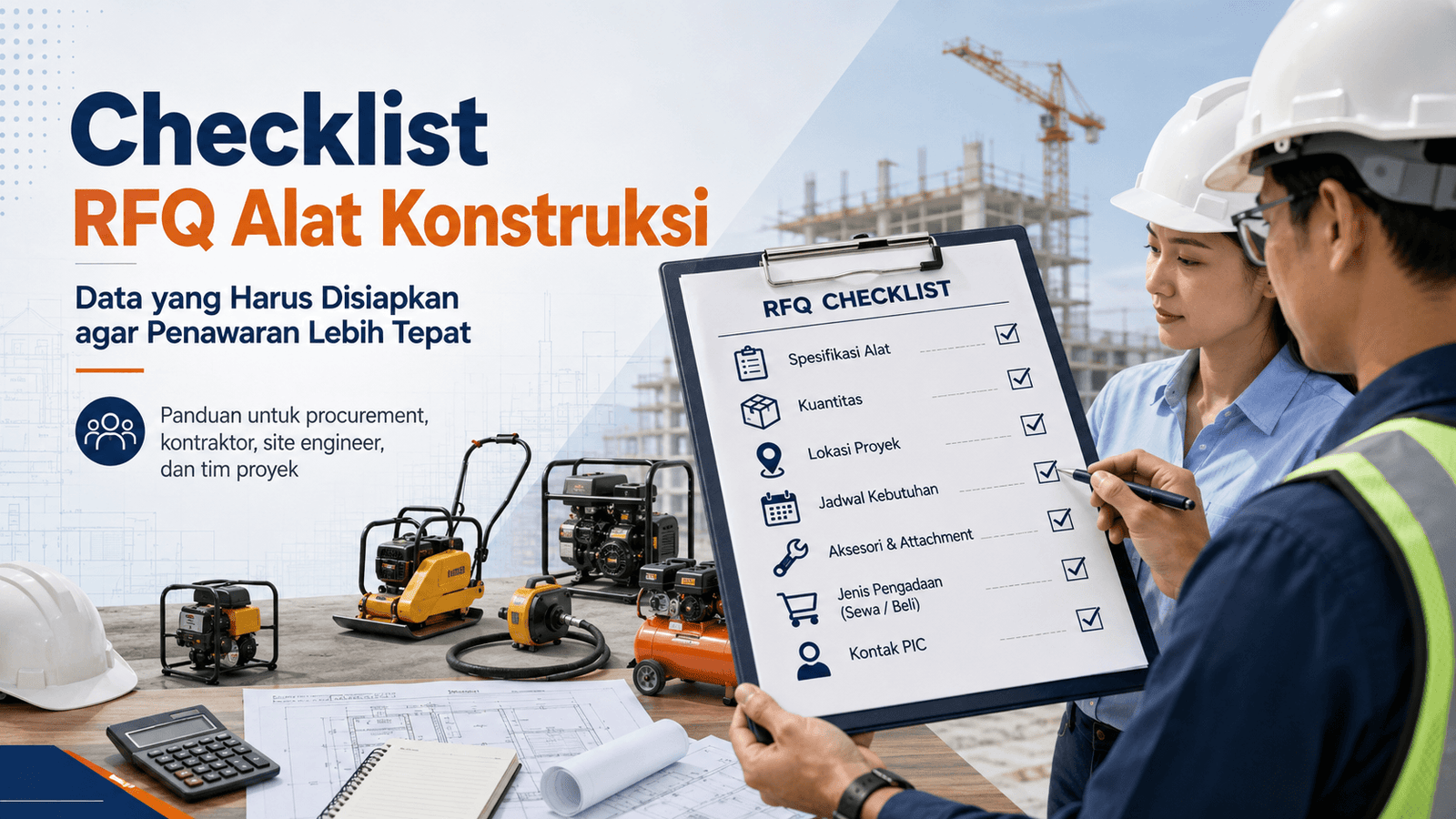
Construction Equipment RFQ Checklist: Information to Prepare for a More Accurate Bid – When requesting a quote for construction equipment, it’s not enough to simply write, “Please provide a price quote for the machinery for the project.”
Such a request does not specify the equipment’s function, required capacity, number of units, operating conditions, project location, schedule, accessories, or the scope of costs that need to be included in the quotation.
As a result, the clarification process may take longer. Other risks include the products being compared not having equivalent specifications, essential accessories not being included in the quote, logistics costs not being factored in, or purchase and rental needs being mixed together in a single request.
By using the construction equipment RFQ checklist, the procurement and purchasing teams, contractors, and project teams can communicate their needs in a more structured manner.
Comprehensive information facilitates the process of assessing needs, matching products, identifying missing data, and preparing more relevant quotations without making any claims regarding price, inventory, lead time, warranty, or availability before confirmation is received.
In This Article
What Is a Construction Equipment RFQ?
RFQ stands for Request for Quotation, which is a request to suppliers to submit proposals based on the technical and commercial requirements that have been outlined.
In the construction equipment procurement process, the RFQ serves as the initial basis for understanding:
- type of work;
- function of the device;
- technical specifications;
- required quantity;
- conditions of use;
- project location;
- need for additional services;
- Commercial information that needs to be confirmed.
An RFQ is not a purchase contract or a guarantee that a specific product is available. An RFQ is an initial document that helps suppliers conduct a technical review and prepare a proposal based on the available data.
For construction equipment needs, RFQs can be used for:
- purchase of new equipment;
- purchase of used equipment;
- equipment rental needs;
- tool kit with accessories;
- needs tender;
- search for alternative products;
- consultation if the model of the device is unknown.
The more complete the information provided, the easier it is to match your needs with the available product options.
Why Do Comprehensive RFQs Lead to More Accurate Quotes?
The goal of procurement is not just to get the best price, but to find the right solution in terms of:
- function;
- quality;
- capacity;
- number;
- time;
- cost;
- location;
- provider.
A comprehensive RFQ helps the project and procurement teams to:
- distinguish between mandatory specifications and preferences;
- reduces the risk of selecting an inappropriate tool;
- compare products using comparable parameters;
- determining whether it makes more sense to purchase or rent;
- make sure no accessories or additional equipment are left out;
- clarify the needs for mobilization, operators, and additional services;
- reduce the need for quotation revisions due to incomplete information.
The right recommendation isn’t based solely on the generic name of the tool. A thorough evaluation must still be conducted by comparing the user’s needs with product data from verifiable sources.
Key Data to Include in a Construction Equipment RFQ
A good RFQ breaks down each requirement parameter so that they can be reviewed one by one.
Applicant and Project Information
Preliminary information you’ll need to prepare:
- company name;
- department or division;
- project name;
- type of work;
- project location;
- The person in charge who can provide clarification.
This data helps ensure that communication and the evaluation process are more effective.
Categories, Functions, and Applications of Tools
Don't just mention the name of the tool.
Example:
Not clear:
Needs a compressor.
To be more specific:
We need a compressor to provide compressed air for specific tasks; the on-site conditions are to be confirmed.
Parameters that need to be explained:
- tool category;
- main function;
- work performed;
- material or application conditions;
- environment of use.
Mandatory and Preferred Technical Specifications
Distinguish between essential needs and preferences.
Required specifications
Parameters that must be met, for example:
- capacity;
- size;
- power source;
- pressure;
- power;
- a specific configuration.
Preference Specifications
Parameters that aid in selection but can still be evaluated:
- a specific design;
- additional features;
- ease of operation;
- custom configuration.
This distinction helps avoid rejecting alternatives that are actually functionally suitable.
Quantity, Condition, and Duration of Use
The RFQ must specify:
- number of units;
- needs-based conditions;
- purchase or rental;
- Rental duration.
Example conditions:
- new;
- used;
- rental;
- To be determined.
For rental purposes, add:
- start date;
- estimated duration of use;
- working hours;
- field conditions.
Accessories, Logistics, and Additional Services
Many discrepancies in quotations occur because supporting details have not been explained.
Make sure the RFQ specifies the following requirements:
- attachment;
- hose;
- cable;
- connector;
- additional equipment;
- operator;
- mobilization;
- demobilization;
- loading and unloading.
Product Identification: Brand, Model, SKU, Part Number, and Serial Number
In the device pairing process, some product IDs have different functions.
Brand
Indicates the manufacturer or brand of the device.
Model
Indicates the product type or variant.
SKU
It is typically used as an inventory management code within a company.
Part Number
Used to identify specific components or parts.
Serial Number
Used to distinguish one physical unit from another.
A photo of the nameplate can aid in the identification process, especially for unit inspections, compatibility checks, spare parts, or component replacements.
However, the information on the nameplate must still be verified against official documents and should not be taken at face value without verification.
How Is the Product Matching Process Conducted?
Once the RFQ is received, the requirements are compared with the available product data from:
- datasheet;
- catalog;
- manual;
- nameplate;
- official product documentation.
The examination results can be categorized as follows:
Full Match
All specifications must be met.
Partial Match
Some of the requirements are met, but there are still parameters that need to be confirmed.
Close Match
The product comes close to meeting the needs, but there are differences that need to be evaluated.
Equivalent Match
The products are different but can be considered equivalent based on agreed-upon parameters.
No Match
There are mandatory requirements that have not been met.
Insufficient Data
The information regarding requirements or product data is incomplete.
Not Found Yet
No products have been found that can be verified based on the available sources.
Matching should not be based solely on product names. Requirements and technical data must be compared first.
Examples of Incomplete RFQs and Better RFQs
Example of an Incomplete RFQ
Please send us the prices for the compaction equipment for our project. We need them immediately and in full.
That information does not explain:
- type of work;
- equipment capacity;
- number of units;
- location;
- purchase or rental;
- duration of use;
- accessories;
- need for additional services;
- Administrative information.
As a result, suppliers need to seek additional clarification before they can prepare their bids.
An Example of a Better RFQ
Company Information:
PT Example Construction — Procurement Division
Job:
Compaction of the project work area
Location of use:
Project destination city
Tool category:
Compaction equipment
Function:
Compaction of materials as required by the job
Brand/model:
Not required; alternatives may be proposed
Required specifications:
In accordance with the technical requirements document
Total:
2 units
Condition:
Please keep the purchase and rental options separate
Rental duration:
Estimates by project period
Accessories:
Please explain what is included and what is not included.
Additional requirements:
Please list transportation, operators, fuel, and loading/unloading separately
This format provides a clearer basis for technical and commercial reviews.
RFQ for Rentals and Points to Clarify in the Quote
When renting equipment, don’t just ask for the “rental price.”.
Separate the following components:
- rental rates;
- minimum period;
- mobilization;
- demobilization;
- operator;
- BBM;
- deposit;
- overtime;
- damage costs;
- accessories;
- loading and unloading;
- site conditions.
In a quotation, the information that needs to be clarified includes:
- unit or package price;
- condition of the item;
- Does tax include this or not?;
- Is shipping included or not?;
- Included accessories:;
- accessories not included;
- the offer period;
- shipment origin;
- confirmed lead time;
- scope of additional services.
Common Mistakes When Requesting a Quote
Some common mistakes:
- mentioning only the generic name of the tool;
- specifying a model without explaining its function;
- combining required specifications and preferences;
- does not specify the number of units;
- does not mention purchase or rental;
- does not specify the location of use;
- sending photos without supporting information;
- does not describe the accessories;
- Assume that shipping costs and taxes are automatically included;
- did not designate a point of contact for clarification.
RFQ Checklist—Ready to Copy
Please use the following format before submitting a request for a quote:
CONSTRUCTION EQUIPMENT RFQ CHECKLIST

Company Name:
Project Name:
Project Location:
Delivery Location:

Equipment Category:
Equipment Function:
Application:

Brand:
Model:
Required Technical Specifications:
Preferred Specifications:

Number of units:
Condition:
Purchase / Rental:

Rental duration:
Required date:

Accessories:
Attachments:
Additional equipment:

Power source:
Site conditions:

Operator:
Mobilization:
Demobilization:
Fuel:
Loading/unloading:

Supporting documents:
Photos:
Data sheet:
Bid documents:

Tax provisions:
Administration:

PIC:
Contact:

Additional notes:
FAQ
Does the RFQ have to include the brand?
Not always. The brand must be listed if required by a tender, company standards, or specific compatibility requirements.
What if the device model is unknown?
Describe the functions, applications, capacity, and required specifications. The selection of a model must still be based on a matching process using the available data.
Does the budget have to be included?
It is not required. The budget can aid in the evaluation if that information can indeed be shared.
What information is required for a rental RFQ?
Minimum:
- type of equipment;
- number;
- location;
- period of use;
- field conditions;
- operator;
- mobilization;
- demobilization.
Why are nameplate photos important?
Because the nameplate can help identify the unit, model, serial number, or specific technical information required for inspection.
Conclusion
The construction equipment RFQ checklist helps procurement, purchasing, and project teams communicate their needs in a more structured way.
Information such as equipment category, function, required specifications, preferences, quantity, condition, application, location, logistics, and additional services needs to be broken down so that it can be reviewed accurately.
The more complete the information provided, the easier it is to match your needs and prepare a quote.
Gather the information about your project requirements, then Submit a consultation request or a request for a quote to the Agung Rejeki team for further investigation.










Add comment
You must be logged in to post a comment.