



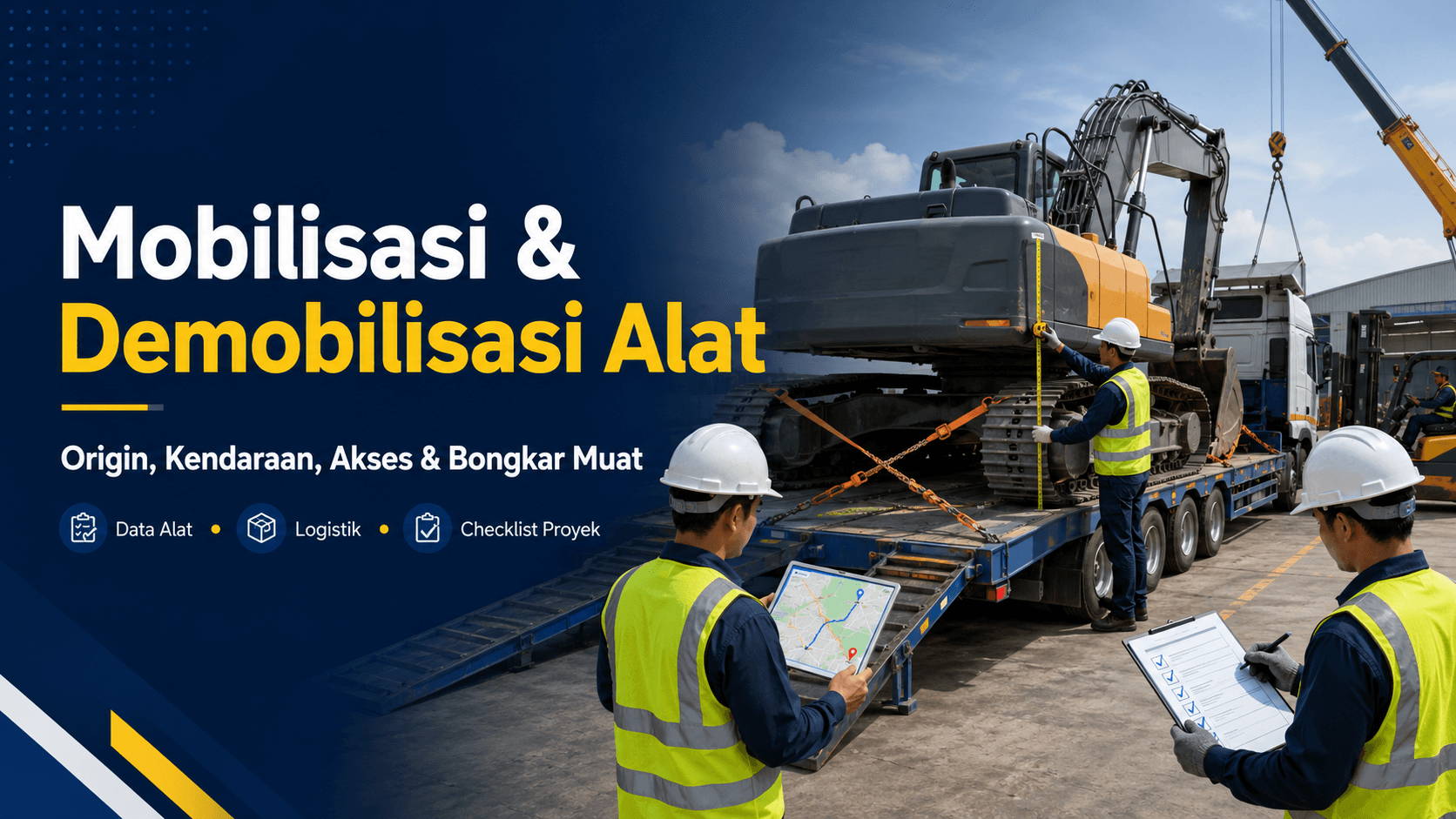
Mobilization and Demobilization of Construction Equipment: What Should Be Considered? – The mobilization of construction equipment is not enough to be planned just by knowing the distance from the point of origin to the project site. Type of tool, weight, dimensions, number of units, attachments, road conditions, vehicle restrictions, loading and unloading needs, schedule entry, and PIC readiness location can affect the entire delivery process.
Demobilization also needs to be planned from the start. After the work is completed, the tool must be able to be removed from the location, examined, collected with the entire attachment, then returned to the agreed point. The condition of access at the end of the project is not necessarily the same as when the tool first entered.
In the discussion Cost Components of Construction Equipment Rentals, mobilization and demobilization are parts that must be separated from unit rates. This article discusses the logistics side more specifically: what data to prepare, what risks need to be examined, and how to divide the responsibility between the tool provider, the user, the transporter, and the project PIC.
The team that will apply RFQ Checklist for Construction Equipment It is advisable to enter mobilization data from the start. This information helps check the needs of vehicles, packing, access to locations, loading and unloading equipment, and the scope of the quotation.
In This Article
What is the mobilization and demobilization of construction equipment?
Mobilization is the process of moving tools, attachments, accessories, and supporting equipment from the point of origin to the location of use.
The process may include:
- unit preparation;
- condition check;
- release of certain components;
- packing;
- lifting to the vehicle;
- binding;
- travel;
- Access checks;
- unit drop;
- and handover on site.
Demobilization is the process of removing, taking back, or moving the tool after the work is completed or the usage period ends.
Demobilization may include:
- notification that the tool has been used;
- condition check;
- Attachment collection;
- cleaning;
- vehicle arrangement;
- loading process;
- transportation;
- and handover at the return location.
The cost and scope of demobilization should not be considered automatic including mobilization. Both need to be mentioned separately in a quotation or agreement.
Why is distance not the only factor?
Two locations with almost the same distance may require different logistical needs.
The difference can be caused by:
- road conditions and class;
- the weight and dimensions of the vehicle and its cargo;
- gate limitation;
- free height;
- turning radius;
- surface conditions;
- area operating hours;
- the need for permission;
- Ferry;
- escort;
- as well as loading and unloading equipment.
The regulation on the transportation of goods on the road requires the fulfillment of provisions regarding the procedures for loading, carrying capacity, vehicle dimensions, and the class of roads traversed. Therefore, the determination of the vehicle should not only be based on distance or visual estimates.
For routes involving crossings, the dimensions and weight of the vehicle and its cargo are also important information in the transportation process.
tool data that must be prepared
Before requesting a mobilization quotation, the tool data needs to be verified.
| Parameters | Required data | Impact on Logistics | Status |
| Tool categories | Types and functions of tools | Help determine how to handle | Required |
| Model | Model identity when known | Help search datasheet | Highly recommended |
| Conditions | new, used, or rental | affect protection and documentation | Required |
| Weight | Actual weight or official data | Basic evaluation of carrying capacity | Required |
| Dimensions | Length, width and height | Basic vehicle selection and route | Required |
| TRANSPORTATION | Size after the components are removed | may differ from operational size | To be confirmed |
| Number of units | Total equipment moved | affect the vehicle and schedule | Required |
| amount of koli | Main unit and separate components | affect packing and inspection | Required |
| Attachment | type, quantity, size | Increases weight, volume and handling | Required |
| Lifting Point | Official information when available | Assisting the lifting process | Highly recommended |
| bond point | Load security information | help with the proper binding | Highly recommended |
| packing | Pallet, crate, wrapping, or open | Protecting tools during the trip | To be confirmed |
| Unit condition | Photos and notes before delivery | Basic handover | Required |
Do not use the weight or dimensions of a similar-looking product. Differences in models, machines, attachments, and configurations can change transportation data.
If technical data is not yet available, use:
The data is not sufficient — the vehicle and the method of transportation have not been established.
Define origin and destination
Origin
Origin is the physical point where the tool will be taken.
Origin is not automatically the same as:
- Provider's office address;
- website address;
- central warehouse location;
- vendor address;
- or the location of the unit in the previous transaction.
If the unit is still in a vendor, customer, other project, or certain warehouse, that location must be checked as an Origin candidate.
Default status if there is no evidence:
Need Confirmation — The origin unit has not been verified.
Origin is required to check:
- distance;
- route;
- type of road;
- toll;
- Ferry;
- pick up time;
- tool readiness;
- loading tool;
- and the sender's pic.
design
The project address should be equipped with operational access information.
The data that needs to be checked include:
- full address;
- coordinate point;
- gate used;
- Entrance hours;
- vehicle type limit;
- gate width;
- free height;
- turning radius;
- road conditions;
- incline or derivative;
- surface bearing capacity;
- waiting area;
- unloading area;
- and the recipient's pic contact.
Administrative addresses are not necessarily enough to determine the route of large vehicles. The project team needs to explain the actual entry point and the condition of the last road to the unloading area.
Choosing a transport vehicle
The transport vehicle must be selected after the data on weight, dimensions, number of units, packing, attachment, and access are available.
Vehicle categories may include:
- pickup;
- Blind Van;
- light truck;
- tailgate truck;
- box;
- ankle;
- double;
- trailer;
- lowbed;
- or special vehicle.
The list is not a final vehicle recommendation. Its suitability must be checked based on the technical data and route conditions.
Use the following status:
| Status | significance |
| Full Match | Capacity, dimensions, and access have met all needs |
| Partial Match | Some parameters are appropriate, but there are parts that still need to be confirmed |
| Close Match | Vehicles are close to need but still have differences or limitations |
| No Match | carrying capacity, dimensions, or access do not meet the needs |
| Insufficient Data | Incomplete data, route, or vehicle data |
The provisions of roads and vehicles in Indonesia take into account, among others, the class of roads, vehicle dimensions, and the heaviest axis load. Vehicles and routes must be checked against applicable regulations, not selected only because the tools are visually visible.
Packing, koli, attachments, and loose fixtures
One tool is not necessarily sent as a koli.
Components that may be sent separately include:
- buckets;
- hose;
- cable;
- panel;
- extension;
- instrument eye;
- guard;
- wheel;
- battery;
- tool kit;
- documents;
- and other attachments.
Each component should be noted with:
- name;
- number;
- condition;
- size;
- weight when available;
- packing method;
- and the placement location.
The method of protection can be pallets, wooden crates, wrapping, corner protectors, waterproof covers, or direct binding. The selection depends on the type of tool, the risk of the trip, the need for the transporter, and the agreed scope.
Packing should not be considered always included in the shipping rate.
road access and location conditions
Access checks should be carried out before the vehicle is dispatched.
Things to ask:
- Can the road be passed by the planned vehicle?
- Are there bridges or culverts with a certain limit?
- Is there a cable, pipe, canopy, or low structure?
- Can the vehicle rotate?
- Is the surface strong enough?
- Is there a sharp incline?
- Does the vehicle need to retreat in a long distance?
- Does the road change when it rains?
- Does the area have an hour limit?
- Does the vehicle have to be registered first?
Road class is related to the ability of the road to receive vehicles based on function, traffic intensity, axis load, and vehicle dimensions. Therefore, the route and access conditions are part of the logistical inspection, not just additional information.
Permits, Restrictions, Escorts, Tolls, and Ferry
Permit requirements may vary according to:
- vehicle type;
- dimensions;
- weight;
- route;
- area;
- load type;
- and location management policies.
Projects in industrial areas, mining, plantations, ports, airports, or locations with special security may request additional documents.
Check for possible needs:
- Travel Letter;
- vehicle data;
- driver data;
- entry permit;
- Safety induction;
- security checks;
- special path;
- escort;
- Ferry reservation;
- and time limit.
Do not include tariffs or declare certain mandatory permits without checking the applicable routes, vehicles, areas and regulations.
Loading and unloading at the project site
Delivery does not necessarily include the process of lowering the tool.
Tools that may be needed include:
- forklift;
- cranes;
- ramp;
- tail lift;
- helper;
- rigging;
- Spreader;
- chain block;
- or special operator.
Before the vehicle arrives, make sure:
- Unloading tools available;
- the capacity is appropriate;
- operators available;
- safe work area;
- stable surface;
- the path of the tool is not blocked;
- and the location pic is ready to accept.
Permenaker Number 8 of 2020 regulates the safety and health of lift and transport aircraft. Processes that use forklifts, cranes, or lift-transport equipment must comply with relevant safety provisions and should not be treated as a regular displacement activity.
mobilization scheduling
The departure schedule must be coordinated with the readiness of all parties.
Check:
- Date of ready unit;
- vehicle ready;
- documents available;
- permission to complete;
- The sender's pic is present;
- The recipient's pic is present;
- ready disassembly;
- Location entry hours;
- weather conditions;
- work in the unloading area;
- and holidays.
Do not send vehicles based on the project date target only if the admission area is not ready.
Waiting time may occur when:
- the gate has not yet given access;
- late dismantling tool;
- PIC is not on location;
- incomplete document;
- Material covered area;
- or other work is still ongoing.
Commercial treatment of waiting time should be explained in the Quotation. Don't make new policies in the article.
Checking condition before delivery
Conditional documentation helps to distinguish the initial state, damage during transportation, and conditions after use.
Documentation may include:
- whole unit photo;
- photos from several sides;
- Nameplate photo;
- panel;
- meters or working hours when relevant;
- tire or track;
- existing leaks;
- dents or scratches;
- attachment;
- accessories;
- as well as a list of components.
Use the handover form that records:
- date;
- location;
- the party who submits;
- the receiving party;
- condition;
- completeness;
- and special notes.
Photos should show conditions clearly, not just ceremonial documentation.
Demobilization process after work
Demobilization needs to be started with a notification that the tool is finished.
Check:
- Is the work really done?
- Are tools still needed for additional work?
- Can the unit be removed from the work area?
- Is exit access still available?
- Does the tool need to be cleaned?
- Has the attachment been collected?
- Are there missing components?
- Has the condition been checked together?
- Is the vehicle scheduled?
- Where will the tool be returned?
The return location should not be assumed to be the same as the initial origin. Units can be directed to warehouses, vendors, other projects, workshops, or other locations based on operational decisions.
Therefore, use the status:
Need Confirmation — Demobilization Destination has not been verified.
responsibilities
| activity | tool provider | tenant/customer | transporter | Location pic | Confirmation Status |
| Provides data of tools | Depends on the unit source | can help from the need document | It cannot be assumed | It cannot be assumed | To be confirmed |
| Define origin | Depends on the physical location of the unit | It cannot be assumed | using the data provided | It cannot be assumed | To be confirmed |
| Determining the vehicle | can give recommendations | Delivering location conditions | Checking the vehicle's ability | provide access data | Depends on the package scope |
| packing | Can be included or separate | can be the responsibility of the customer | can have requirements | It cannot be assumed | specified in the Quotation |
| loading | Provider can be prepared | Customers can be prepared | can help according to the scope | Setting the area | specified in the Quotation |
| Travel permit | Depend on the vehicle and route | provide area data | Can manage according to scope | Taking care of location permits | To be confirmed |
| Loading and unloading | not automatically included | can be the responsibility of the customer | Depends on the service | Setting up the area | specified in the Quotation |
| Conditioning documentation | can be done together | can be done together | Record the conditions of transportation | Signing the admission | Highly recommended |
| Demobilization | Can be scheduled provider | Give a notification of completion | Preparing the vehicle | Setting up access to exit | Depends on the package scope |
| Insurance | It cannot be assumed | It cannot be assumed | available according to the service | It cannot be assumed | To be confirmed |
Article Logistics Status
| Components | Determination status | prospect |
| Origin | Need Confirmation | The physical location of the unit is not yet available |
| design | Need Confirmation | must be based on actual project |
| vehicle | Quote-Based | requires weight, dimensions, and access |
| rate | Quote-Based | No approved rate card |
| packing | Need Confirmation | Depends on tools and transporters |
| Loading and unloading | Need Confirmation | cannot be considered as |
| permit | Need Confirmation | Depends on vehicle, route and region |
| Insurance | Need Confirmation | Scope is not yet available |
| declining | Need Confirmation | Depends on the readiness of the unit and |
| Demobilization Destination | Need Confirmation | The return location has not been determined |
Example of incomplete request
Please send the tool to the project site.
The request has not explained:
- type of equipment;
- number;
- weight;
- dimensions;
- the number of coli;
- attachment;
- origin;
- destination address;
- road conditions;
- vehicle limits;
- packing;
- loading and unloading;
- date;
- assistive devices;
- and pic.
Transporters or providers do not have sufficient basis to determine the vehicle and scope.
better example of request
Category: Model, if known: NU Number of Units: Unit Condition: Actual Weight: Unit Dimensions Unit: MENS Transportation Dimensions: ColiseAmount: Colie: ATTACHMENT: ATTACHMENT: PACKING CASE: CASE ONLY ORIGIN: 20000000000000000000000000000000000000000000000000000000000000000000000000000000000000000000000000000000000000000000000000000000000000000000000000000000000000000000000000000000000000000000000000000000000000000000000000000000000000000000000The format has not automatically generated a final quotation, but helps the initial inspection process.
Mobilization and demobilization checklist
- The type of tool is determined.
- The number of units is clear.
- The weight and dimensions have been verified.
- The dimensions of transportation have been checked.
- Attachments are registered.
- The number of coli is known.
- Packing is determined.
- Origin has been confirmed.
- The destination address is complete.
- The coordinates or gate points are available.
- Vehicle access has been checked.
- The location time is known.
- Permission has been checked.
- The vehicle has not been selected before complete data.
- The dismantling tool has been prepared.
- Unloading tool operators are available.
- The sender's pic has been determined.
- The recipient's pic is already specified.
- The condition of the unit has been documented.
- The mobilization schedule has been agreed.
- The demobilization schedule is expected.
- The return location has been confirmed.
- The scope of the fee is written.
Common Mistakes
Mistakes to avoid:
- Calculate the need only by distance.
- Using the office address as origin without confirmation.
- Not checking the actual weight and dimensions.
- not record attachments.
- Not checking the amount of coli.
- Select a vehicle before complete technical data.
- Not checking gate access and turning radius.
- Not setting up forklifts, cranes, or ramps.
- Not pointing to the sender and receiver pic.
- Not paying attention to permissions and entry hours.
- not documenting the initial conditions.
- consider demobilization is included.
- Assuming postage is included in the loading and unloading.
- Does not specify the return location.
- Using the app estimate or marketplace as a final quotation.
FAQ
What is the difference between mobilization and demobilization?
Mobilization is the process of moving the tool to the location of use. Demobilization is the process of removing and returning or moving the tool after the work is complete.
Is mobilization always calculated based on distance?
No. Distance is only one factor. Weight, dimensions, vehicles, access, permits, ferries, loading and unloading, and location conditions can also affect the scope.
Why is the weight and dimensions of the tool required?
The data is needed to evaluate the carrying capacity of the vehicle, the dimensions of the cargo, the route, access, and the need for the dismantling equipment.
Does the attachment affect delivery?
Yes. Attachments can increase the weight, volume, number of koli, packing needs, and loading and unloading equipment.
Who prepares a forklift or crane?
cannot be assumed. The responsibility must be mentioned in the Quotation or shipping documents.
Does loading and unloading include postage?
Not necessarily. Actual details should be checked in a quotation, travel letter, or agreement because the scope of each transaction may be different.
Why should the origin unit be confirmed?
Origin determines pick up point, route, distance, loading tool, and schedule. Office address is not necessarily the physical location of the unit.
Is demobilization paid separately?
Can be separated or become part of a certain package. The scope must be explained in writing.
What data needs to be sent to request a quotation?
Send tool type, number, weight, dimension, koli, attachment, origin, destination, access, schedule, loading and unloading, and pic.
What to check before the tool is taken back?
Check the condition of the unit, completeness of the attachment, cleanliness, exit access, loading equipment, vehicles, documents, and return locations.
Conclusion
Mobilization and demobilization of construction equipment requires more than the calculation of the distance. Data on tools, origin, destination, vehicle, packing, access, permits, loading and unloading, schedule, and unit condition need to be checked as a series.
Vehicles may not be determined before weight, dimensions, number of koli, attachments, and route conditions are available. Demobilization must also be planned from the start so that the tool can come out, be inspected, and returned without disturbing the project schedule.
prescription Buy or rent construction equipment It is also necessary to take into account the displacement of the interlocation of equipment because the cost and risk of transportation may appear more than once during the period of use.
Are you preparing to mobilize the equipment to the project site? Prepare the type of tool, weight, dimensions, origin, purpose, condition of access, loading and unloading needs, and schedule so that the logistics scope can be checked more precisely. Contact the Great Fortune Team for project requirements consultation and requests for quotes.









Add comment
You must be logged in to post a comment.